
Itineraries · 6 min · · by Sofia Ramirez
How many days at Iguazu Falls: three, without rushing
Short answer
How many days do you need at Iguazu Falls?
How many days at Iguazu Falls: three. One for the Argentine side, where the walkways run for kilometres and the water gets close enough to soak you. One for the Brazilian panorama. Half a day spare for the boat or the bird park. The two sides are separate countries, so the crossing takes part of a day.
What this guide covers
- Argentine side vs Brazilian side
- Do you need a Brazilian visa? Since April 2025, some passports do
- How long each circuit takes to walk
- Where to sleep: town or park hotel
- Rainy season and water levels
Key Takeaways
- Iguazu is not one waterfall. It is a wall of 275 drops, 2.7 km across, split between two national parks that face each other over a river.
- Roughly 80% of the water is on the Argentine side. That is why the Argentine park takes a full day and the Brazilian park takes half of one.
- Do the Argentine side first. Close up, then wide. In the other order the walkways feel like a footnote to the panorama.
- Since 10 April 2025, US, Canadian and Australian passports need a Brazilian e-visa. It is online, it takes days rather than weeks, and nobody sells it to you at the bridge.
How many days at Iguazu Falls, and why two is not enough
Two days is the itinerary most people arrive with, and it is the one that produces the complaint we hear most often: they saw the falls and never stopped moving.
The arithmetic is simple. The Argentine park has three separate walking circuits, a park train and a boat. The Brazilian park has one trail and a bus. Add a land border between them, with passport control on both sides, and two days means one of the three things gets cut on the morning of.
Three days gives you one park per day and a spare half day. The spare is not padding. It is where the boat goes if the river was too high on day one, or where the bird park goes if it rained, or where you go back to a viewpoint you liked at a quieter hour.
We build the 4-day Argentina and Brazil Iguazu Falls package on the same shape: two park days, one crossing, and time that is not already spent.
Which side of Iguazu Falls to do first
Argentine side first. Every time.
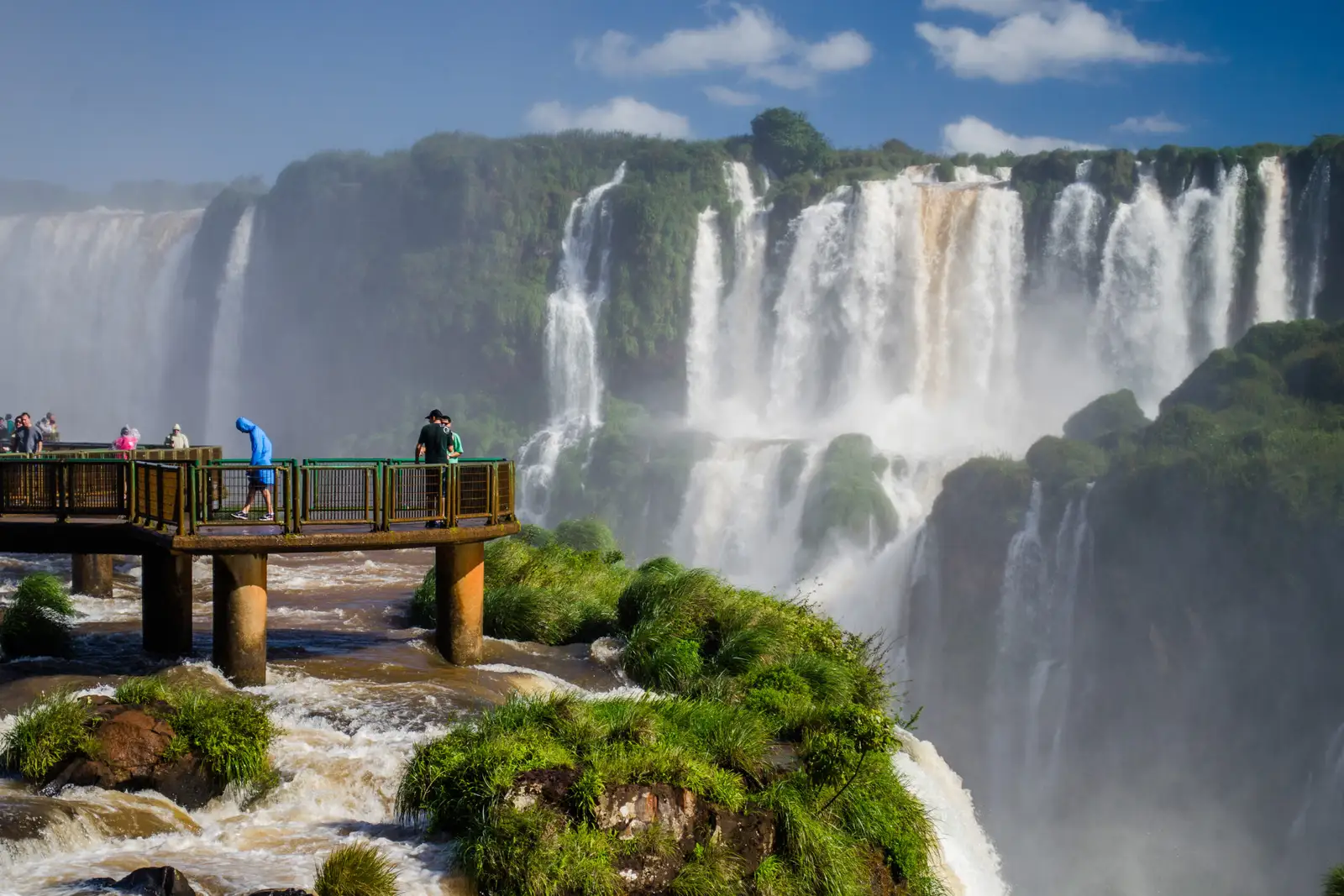
The Argentine park puts you inside the system. The walkways sit above, beside and underneath individual drops. You get wet, you lose track of how many falls you have counted, and you finish the day without a single photograph that contains the whole thing.
Then Brazil gives you the whole thing. One paved trail along the opposite bank, ending on a catwalk that runs out into the spray. It is the shot everyone has seen. Seen second, it explains the day before. Seen first, it makes the day after feel like detail.
The Argentine side: three circuits and a train
The park runs three separate circuits, and knowing the shape of each makes planning a walking day straightforward rather than a guess.
The lower circuit includes flights of stairs. It is the one that takes you down to river level and under the falls, and it is where most of the two hours goes.
The upper circuit runs along the top of the drops, on flat walkway. Allow an hour and a half.
The Devil’s Throat circuit is a boardwalk out to the platform over the biggest drop, reached by the park train. This is the one that closes when the river runs high, so check the park’s own status page the week you travel and again the night before.
If you have a spare morning and good weather, the Macuco trail is 7 kilometres of forest track with no services on it, ending at a small waterfall you can swim under. It is the only part of the park where you are likely to be alone.
The Brazilian side: one trail, and the photograph
The Brazilian trail is paved, mostly flat and takes two to three hours if you stop where everyone stops. Buses run along it, so you can skip sections and still reach the catwalk.
Book the Brazilian side panoramic experience as a half day and keep the afternoon for the bird park next door, which shares the entrance road.
The border, and the visa that changed
The crossing itself is routine. A bus or a car, a bridge over the Iguazu river, a stamp on each side. Forty minutes door to door when there is no queue, and up to two hours on a holiday weekend.
The paperwork stopped being routine in 2025. Brazil reinstated visitor visas for three nationalities, and the e-visa covers stays of up to 90 days with multiple entries. US, Canadian and Australian passports need one. UK, EU and most Latin American passports do not.
It is applied for online and it arrives by email. Do it when you book the trip, not the week you fly, and print it. A guide cannot walk you through a border you are not cleared for.
Two more practical notes on the crossing. The parks run separate ticket systems, so the Brazilian gate will not take Argentine pesos, and card is easier than either currency. Our guide to paying in Argentina covers what that costs you on the Argentine side of the bridge.
When to go, and what the water does
There is no dry season at Iguazu, which is why the question is really about crowds and water level.
High water gives you a louder, wider, more violent set of falls and a higher chance that the Devil’s Throat walkway is shut. Low water gives you the rock formations, the individual drops and a guaranteed platform. Neither is the good version. They are different waterfalls.
The dates that actually matter are the Argentine school holidays, in January and again in July. The parks are full, the walkways move at the pace of the slowest group, and the boat sells out. If you can move a week either side of those, do.
Whatever the month, be at the gates before 09:00. The lower circuit is quiet for the first hour and shoulder to shoulder by eleven.
How many days at Iguazu Falls, by how long you have
| You have | What fits |
|---|---|
| One day | One side only. Take the Argentine circuits and accept that you are missing the panorama |
| Two days | Both sides, one each, with the border crossing eating into the second |
| Three days | Both sides at their own pace, plus the boat or the bird park |
| Four days | The above, plus a day inland to San Ignacio and Wanda, or a slow morning |
Three is the number that stops the trip feeling like a transfer schedule. If you are choosing between the extras rather than the days, our guide to things to do at Iguazu Falls has the prices and the age limits.
Where to sleep
Puerto Iguazu, on the Argentine side, is the practical base for three days: it is 20 minutes from the park, it has the restaurants, and it is where the transfers start. Foz do Iguacu, on the Brazilian side, works if your flights land there.
There is also one hotel inside each park. They cost what a view of the falls from your window costs, and they buy you the hour before the gates open and the hour after they close. On a three-day trip that is the only real luxury on offer here.
For the fuller picture of the two parks, the towns and what else is within a day, see the Iguazu Falls place guide. If Iguazu is one leg of a longer trip, most people fly in from Buenos Aires, and our 3 days in Buenos Aires itinerary is built to hand over to this one.
Places in this guide
Frequently asked
Which side of Iguazu is better?
The Argentine side gives you hours of close-up walkways; the Brazilian side gives you the postcard panorama. Three days lets you do both properly.
Do you need a visa to cross into Brazil?
US, Canadian and Australian passports do, since 10 April 2025. It is an e-visa, applied for online, valid for stays up to 90 days. UK, EU and most Latin American passports do not. Apply before you fly.
Is the boat ride worth it?
If you don't mind being soaked, yes. Bring a dry bag and a change of clothes.
Can you see both sides in one day?
You can, and you will spend most of it queuing at a border and on a bus. One side per day is the difference between seeing the falls and photographing them from a moving vehicle.