
Practical · 6 min · · by Sofia Ramirez
Bariloche circuits compared: which to pick
Short answer
Which Bariloche circuit should you book?
Bariloche circuits compared come down to how much driving, climbing or sailing you want. Circuito Chico is the easiest, a lakeside loop under four hours. Circuito Grande covers more ground on a longer drive to Villa Traful and Villa La Angostura. Cerro Catedral and Cerro Otto swap the road for a lift up the mountain, and Puerto Blest swaps it for a boat to a waterfall.
What this guide covers
- Bariloche circuits compared: what each one covers
- Circuito Chico: the standard half-day, on the shore of Nahuel Huapi
- Circuito Grande: the full day out to Villa Traful and Villa La Angostura
- Cerro Catedral vs Cerro Otto: two ways up, two different summits
- Puerto Blest: the boat trip that isn't a circuit
- Bariloche circuits compared: which one to pick
Key Takeaways
- Bariloche’s half-day trips split into three kinds: scenic drives, mountain climbs and lake navigation, and they cover different ground.
- Circuito Chico loops about 60km round Nahuel Huapi’s shoreline, past Cerro Campanario and the Llao Llao peninsula, in 3.5 to 4 hours with a guided tour.
- Circuito Grande covers roughly 240km out to Villa Traful and Villa La Angostura, a 9 to 10 hour day on the Seven Lakes route.
- Cerro Catedral’s lifts run from a base near 1,000 metres up to about 2,000 metres; Cerro Otto’s cable car tops out at 1,405 metres, where a revolving café looks out over the lake.
- Puerto Blest trades the road for a boat: about an hour across Nahuel Huapi’s Blest arm to a waterfall and an old stand of rainforest.
Bariloche circuits compared: what each one covers
Bariloche sits on Nahuel Huapi lake, in the Argentine Lake District. Five different half-day trips leave from town, and they don’t overlap much: two are scenic drives round the lake, two climb a mountain by lift, and one gets there by boat instead of a road.
| Circuit | What it covers | Duration | Difficulty | Who it suits |
|---|---|---|---|---|
| Circuito Chico | Scenic drive round Nahuel Huapi’s shoreline: Cerro Campanario, the Llao Llao peninsula, a lookout over Lago Moreno | 3.5-4 hours | Easy | A first half-day, or a mixed-age group |
| Circuito Grande | Full-day drive to Villa Traful and Villa La Angostura on the Seven Lakes route | 9-10 hours | Easy | A second day, more road and fewer crowds |
| Cerro Catedral | Gondola and chairlifts up a working ski mountain, to about 2,000 metres | 4 hours | Easy | Height, and a mountain with real infrastructure |
| Cerro Otto | Cable car to a 1,405-metre summit with a revolving café | 3 hours | Easy | A shorter, closer mountain trip |
| Puerto Blest | Boat across the Blest arm to a waterfall and Valdivian rainforest | 8 hours | Easy | Swapping the road for a lake, and wanting a waterfall |
All five run daily and none carries a fitness restriction, per Lati’s own booking terms for each tour. The choice is really about how much time you have and what you want to look at: a lake from the shore, a lake from above, or a lake from a boat.
Circuito Chico: the standard half-day, on the shore of Nahuel Huapi
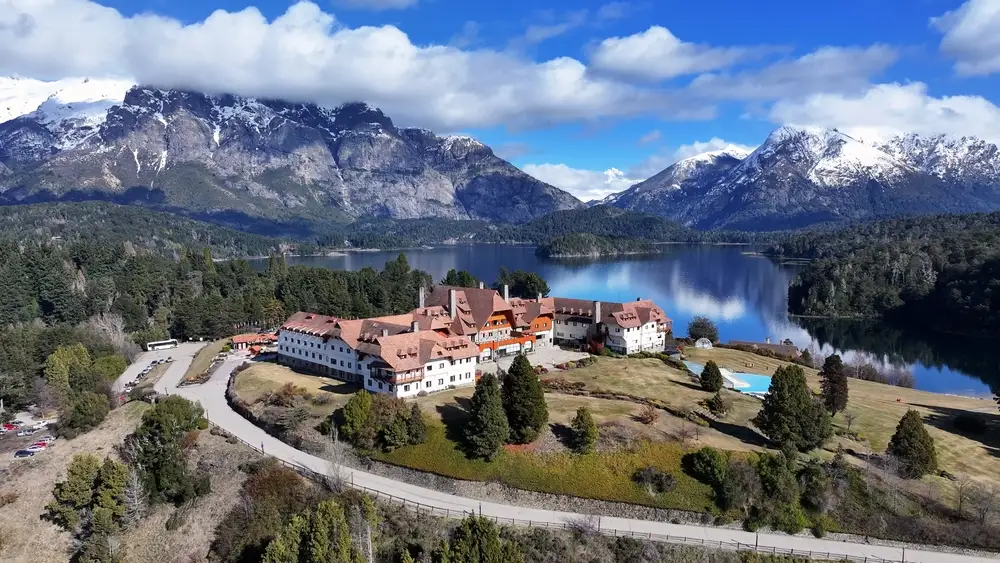
Circuito Chico is about 60km, starting and ending in Bariloche. The route passes Cerro Campanario around km 17, then reaches the Llao Llao peninsula near km 23, where the Llao Llao Hotel, the San Eduardo Chapel and Puerto Pañuelo sit close together. Further on, a panoramic lookout at km 40 sits at 945 metres, over Lago Moreno. With a guided tour it takes 3.5 to 4 hours; driving it independently, with stops, the same source says it can take most of a day.
Lati’s own Circuito Chico tour runs a similar route in about four hours, from US$38 per person, with an optional stop at the Cerro Campanario chairlift. It’s the most straightforward way to see the shoreline everyone photographs, without committing to a full day.
Circuito Grande: the full day out to Villa Traful and Villa La Angostura
Circuito Grande leaves the lake behind for longer stretches of road. It runs about 240km, out through the Valle Encantado’s rock formations and Confluencia, where the Traful and Limay rivers meet, then along Lake Traful to Villa Traful itself. From there it continues to Villa La Angostura, past Lakes Correntoso and Espejo, closing the loop on National Route 40’s Seven Lakes stretch. With a tour it’s a 9 to 10 hour day; part of the route, on Provincial Route 65, is unpaved and can close in bad weather.
Lati’s Circuito Grande tour covers the same ground in 9 hours, from US$62 per person. It suits a second day in Bariloche, once Circuito Chico has already covered the closer shoreline.
Cerro Catedral vs Cerro Otto: two ways up, two different summits
Cerro Catedral and Cerro Otto both put you above Bariloche by lift, but they’re built for different days. Catedral’s base sits around 1,000 metres, with lifts reaching about 2,000 metres, and the mountain is the largest ski resort in the southern hemisphere, according to Bariloche’s official tourism site, with 120km of marked runs in winter. In summer the same lifts serve hikers and mountain bikers instead of skiers. It’s roughly 40km round trip from town.
Cerro Otto is lower and closer, about 10km from the centre of Bariloche. Its cable car runs 42 four-person cabins over a 2,100-metre line to a 1,405-metre summit, where a café rotates a full circle in about 20 minutes. Transfers from downtown to the base station are included in the ascent rate.
Lati runs both as separate half-days: Cerro Catedral in 4 hours from US$40, and Cerro Otto in 3 hours from US$35. Catedral gives more height and a working mountain to explore; Otto is the shorter trip, with the revolving café as its own reason to go.
Puerto Blest: the boat trip that isn’t a circuit
Puerto Blest isn’t a road circuit at all. The boat leaves Puerto Pañuelo, on the Llao Llao peninsula, and sails about an hour across Nahuel Huapi’s Blest arm, passing Centinela Island, where the ashes of the explorer known as Perito Moreno rest. From the far shore, a path climbs through Valdivian rainforest to Cascada de los Cántaros and a larch tree estimated at 1,500 years old. A short sail of about five minutes then reaches Puerto Blest itself, on a bay fed by the Frías River. An optional extension continues onto Lake Frías.
Lati’s Puerto Blest tour runs 8 hours from US$138 per person, the highest-priced of the five: it’s the only one that includes a boat rather than a coach, and covers rainforest the road circuits don’t reach.
Bariloche circuits compared: which one to pick
Short on time, or in town for one half-day: Circuito Chico covers the shoreline everyone comes for, with no fitness bar to clear and a route short enough to add a second stop afterwards.
Staying long enough for a second full day, and wanting more road and fewer people: Circuito Grande reaches villages Circuito Chico never gets close to.
Set on a mountain rather than a lakeside road: choose by what you want at the top. Cerro Catedral gives more height and a working ski mountain to walk around; Cerro Otto is the shorter, closer trip, built around its revolving café.
Wanting a waterfall and old rainforest over another viewpoint: Puerto Blest is the one built around a boat instead of a road.
Our Bariloche place guide covers the rest of the town, including where these trips fit against a longer stay. If the dates aren’t fixed yet, the Patagonia season guide covers when the lake district works best. And for the ice-and-steppe side of Patagonia further south, Perito Moreno glacier tours compared runs through the same kind of choice for El Calafate.
Places in this guide
Frequently asked
What is the difference between Circuito Chico and Circuito Grande?
Circuito Chico is the short loop around Nahuel Huapi's shoreline, about 60km and under four hours, past Llao Llao and Cerro Campanario. Circuito Grande is the full-day version, roughly 240km out to Villa Traful and Villa La Angostura on the Seven Lakes route, and takes 9 to 10 hours with a guided tour.
Should I book Cerro Catedral or Cerro Otto?
Cerro Catedral's lifts climb higher, from a base near 1,000 metres to about 2,000 metres, and the mountain is also South America's largest ski resort. Cerro Otto is lower, topping out at 1,405 metres, closer to town, and built around a revolving café rather than ski infrastructure. Neither trip needs trekking experience.
How long does Circuito Chico take?
About 3.5 to 4 hours with a guided tour, covering the roughly 60km loop past Cerro Campanario, the Llao Llao peninsula and a lookout over Lago Moreno. Driving it independently, with stops, can take most of a day.
Is Puerto Blest part of one of Bariloche's circuits?
No. Puerto Blest is a boat trip, not a road circuit: it sails from Puerto Pañuelo across Nahuel Huapi's Blest arm to a waterfall and a stand of Valdivian rainforest, with an optional extension onto Lake Frías. It leaves from the same area as Circuito Chico but doesn't share its route.