
Practical · 6 min · · by Sofia Ramirez
Buenos Aires public transportation: subte, taxis and apps
Short answer
How do you get around Buenos Aires day to day?
Buenos Aires public transportation runs on a subte with six lines, more than 180 bus routes and metered taxis. Since December 2024 the subte also takes a contactless bank card or phone at the same fare as a SUBE card, and city buses added the same option by May 2025. Uber, Cabify and DiDi are legal, ruled so by the city's top court in 2020, though a May 2026 ruling now requires their drivers to hold the same licence and insurance as taxis.
What this guide covers
- Buenos Aires public transportation at a glance
- The subte: six lines, and how far a SUBE card actually gets you
- Colectivos: the bus network that reaches everywhere the subte doesn't
- Taxis and remises: metered, official, easy to book
- Uber, Cabify and DiDi: legal, with new rules from 2026
- Buenos Aires public transportation: which one to actually use
Key Takeaways
- The subte has six lines, A through E and H, running roughly 5.30am to 11.30pm on weekdays, according to the city’s official tourism site.
- A contactless bank card or phone works on every subte turnstile since 2 December 2024, at the same fare as SUBE, no registration needed.
- All bus lines inside the city finished the same rollout by May 2025. Outside city limits, SUBE is still the only way to pay.
- A short subte or bus ride costs under $1,700 pesos as of 1 August 2026; a metered taxi starts at $1,920 plus distance and time.
- Uber, Cabify and DiDi are legal, but a May 2026 court ruling now holds their drivers to the same licensing and insurance rules as taxis.
Buenos Aires public transportation at a glance
| Mode | Typical cost (1 Aug 2026) | Best for | How to pay |
|---|---|---|---|
| Subte | $1,684 per ride with a registered SUBE card | Crossing the city fast, away from surface traffic | SUBE, or a contactless card or phone since Dec 2024 |
| Colectivo (bus) | From $852.90 for up to 3km | Short hops and routes the subte doesn’t reach | SUBE everywhere; contactless card or phone on city lines since May 2025 |
| Taxi | $1,920 flag fall + $192 per 200m or minute waiting | Late at night, with luggage, or a fixed pickup | Cash, or card through the official BA Taxi app |
| Uber / Cabify / DiDi | Dynamic in-app pricing | Door to door, no need to hail on the street | Card on file in the app |
These are the fares that took effect on 1 August 2026, a 3.9% rise on the month before. Argentina’s transport fares move with inflation, so treat the pesos as a snapshot rather than a fixed price.
The subte: six lines, and how far a SUBE card actually gets you
Buenos Aires’ underground network has six lines, A through E and H, reaching most of the neighbourhoods a first-time visitor stays in, San Telmo and Recoleta among them. Trains run every three to ten minutes, from about 5.30am to 11.30pm Monday to Friday, 6am to midnight on Saturdays and 8am to 10.30pm on Sundays and public holidays, per the city’s official tourism site.
Since 2 December 2024, every turnstile also reads a contactless Visa or Mastercard, debit or credit, and phones or watches with NFC. The fare is identical to SUBE, and there’s no sign-up or app download first. A SUBE card still matters for two things a bank card can’t do: Red SUBE’s discount on your second and third trip within the transfer window, and the reduced fare for students, retirees and people with disabilities, both still SUBE-only.
Colectivos: the bus network that reaches everywhere the subte doesn’t
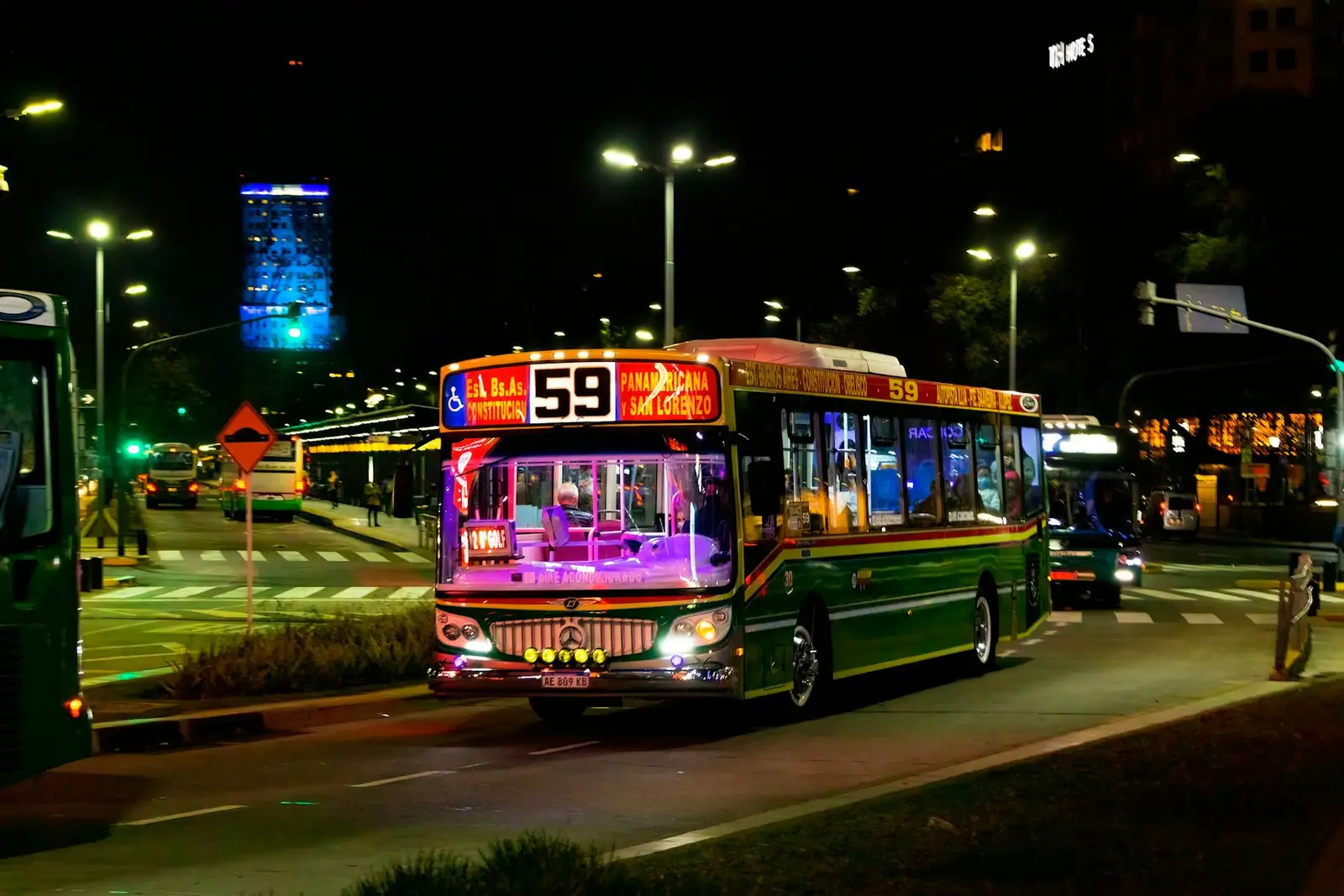
Buenos Aires runs more than 180 bus lines, covering the city around the clock, with several routed along Metrobus lanes that keep buses out of general traffic. It’s the way to reach a neighbourhood the subte skips, and often the more direct option even where the two overlap.
All bus lines inside the city limits finished switching over to contactless card and phone payment by May 2025, following the subte. Step outside CABA into the wider Buenos Aires province and a SUBE card becomes the only option again, along with national trains, which have not added card payment. Fares scale with distance: up to $852.90 for a trip under 3km, rising to $1,093.77 for 12 to 27km, with a registered SUBE card, as of 1 August 2026.
A SUBE card is sold at subte stations, at the city’s tourist assistance centres and at kiosks carrying the SUBE sign, and it’s loaded with cash the same way. Loading it online still needs a tap at a station machine or on board a bus before the credit registers.
Taxis and remises: metered, official, easy to book
Official taxis are black and yellow, metered, and identified by a licence sticker on the front doors. The current tariff is $1,920 on the flag fall, plus $192 for every 200 metres travelled or minute spent waiting, with a 20% surcharge overnight between 10pm and 6am. A remise is booked in advance through an agency rather than hailed, at a fare agreed before the trip starts.
The city government runs its own free app, BA Taxi, to book an official taxi, see the driver’s details before it arrives and pay by card instead of cash. Radio taxis, dispatched by a base rather than flagged on the street, are the safer choice of the two if you’re travelling alone or at night.
Uber, Cabify and DiDi: legal, with new rules from 2026
Ride-hailing has operated in a genuine grey area in Buenos Aires for years, and it’s worth being precise about where that stands now rather than repeating an older answer. The city’s Tribunal Superior de Justicia ruled Uber’s activity legal in September 2020, closing the case the city government had brought against it and lifting the card and app blocks that came with it.
That legality doesn’t mean the apps are unregulated. A ruling published on 8 May 2026 found that Uber, Cabify and DiDi drivers had been operating in a legal gap that let them skip requirements taxis and remises already meet. Drivers on all three apps must now hold a professional driving licence, passenger and third-party insurance, and pass the same vehicle checks as a taxi, with a 90-day window the city government announced to comply. None of that changes how you book a ride: open the app, see the driver and car before they arrive, and pay with the card on file.
Buenos Aires public transportation: which one to actually use
For a short hop between neighbourhoods with no luggage, the subte or a bus is the cheapest and often the fastest option once you count parking a car or waiting for one to arrive. A taxi or a rideshare app earns its price at night, with bags, or when the nearest subte station is further than you’d like to walk. None of it requires planning ahead: a SUBE card, a contactless bank card and a rideshare app cover the whole list. Pay for tours in the currency they’re priced in and keep pesos for transport and small purchases, which our guide to paying in Argentina covers in more detail.
Lati Travel’s Best of Buenos Aires City Tour covers the main sights by bus with a guide, which is a fair way to see the layout of the city before deciding how you’ll get around it on your own. Our 3-day Buenos Aires itinerary plans a full visit by neighbourhood, with this guide as the reference for moving between them.
Places in this guide
Frequently asked
Do I need a SUBE card to ride the subte in Buenos Aires?
No, not since 2 December 2024. Every subte station accepts a contactless debit, credit or prepaid Visa or Mastercard, or a phone wallet over NFC, at the same fare as SUBE. A SUBE card is still the only way to get the discounted second and third trip within the transfer window.
Are Uber, Cabify and DiDi legal in Buenos Aires?
Yes. The city's Tribunal Superior de Justicia ruled Uber's operation legal in September 2020, ending a long court dispute. A May 2026 ruling from a different court now requires drivers on all three apps to hold a professional driving licence and passenger insurance equivalent to taxis and remises, with a 90-day window to comply.
How much does a taxi cost in Buenos Aires?
The metered fare starts at $1,920 on the flag fall, plus $192 for every 200 metres travelled or minute spent waiting, per the city government's official tariff page. A 20% surcharge applies overnight, between 10pm and 6am.
Where can I buy and load a SUBE card as a tourist?
At subte stations, at any of the city's tourist assistance centres, or at kiosks that display the SUBE sign. Loading works the same way: insert cash at a subte station machine or a lottery terminal. Loading online needs a later tap at a machine or on a bus to register.